Moose
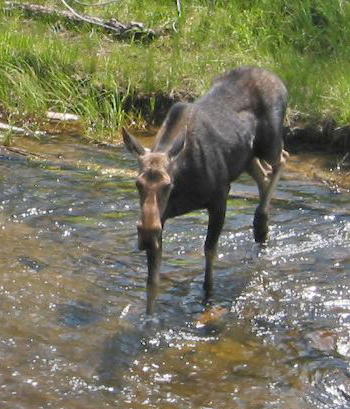 | image = Alaska moose.jpg
| image_caption = A bull (male) moose in Alaska, US
| image2 = Alce (Alces alces), Potter marsh, Alaska, Estados Unidos, 2017-08-22, DD 139.jpg
| image2_caption = A cow (female) moose in Alaska, US
| status = LC
| status_system = IUCN3.1
| status_ref =
| status2 = G5
| status2_system = TNC
| status2_ref =
| taxon = Alces alces
| display_parents = 2
| authority = (Linnaeus, 1758)
| range_map = Moose distribution.png
| range_map_caption =
| synonyms = :''Cervus alces''
}}
| image = Alaska moose.jpg
| image_caption = A bull (male) moose in Alaska, US
| image2 = Alce (Alces alces), Potter marsh, Alaska, Estados Unidos, 2017-08-22, DD 139.jpg
| image2_caption = A cow (female) moose in Alaska, US
| status = LC
| status_system = IUCN3.1
| status_ref =
| status2 = G5
| status2_system = TNC
| status2_ref =
| taxon = Alces alces
| display_parents = 2
| authority = (Linnaeus, 1758)
| range_map = Moose distribution.png
| range_map_caption =
| synonyms = :''Cervus alces''
}}The moose (: 'moose'; used in North America) or elk (: 'elk' or 'elks'; used in Eurasia) (''Alces alces'') is the world's tallest, largest and heaviest extant species of deer and the only species in the genus ''Alces''. It is also the tallest, and the second-largest, land animal in North America, falling short only to the American bison in body mass. Most adult male moose have broad, palmate ("open-hand shaped") antlers; other members of the deer family have pointed antlers with a dendritic ("twig-like") configuration. Moose inhabit the circumpolar boreal forests or temperate broadleaf and mixed forests of the Northern Hemisphere, thriving in cooler, temperate areas as well as subarctic climates.
Hunting shaped the relationship between moose and humans, both in Eurasia and North America. Prior to the early modern period (around 1600–1700), moose were one of many valuable sources of sustenance for certain North American Indians. Hunting and habitat loss have reduced the moose's range; this fragmentation has led to sightings of "urban moose" in some areas. The moose has been reintroduced to some of its former habitats. Currently, the greatest populations occur in Canada. Additionally, substantial numbers are found in Alaska, the northern states of the contiguous United States, Fennoscandia, the Baltic states, the Caucasus region, Poland, Eastern Europe, Mongolia, Kazakhstan, and Russia.
Predominantly a browser, the moose's diet consists of both terrestrial and aquatic vegetation, depending on the season, with branches, twigs and dead wood making up a large portion of their winter diet. Predators of moose include wolves, bears, humans, wolverines (rarely, though may take calves), and (rarely, if swimming in the ocean) orcas. Unlike most other deer species, moose do not form herds and are solitary animals, aside from calves who remain with their mother until the cow begins estrus again (typically 18 months after the birth of a calf). At this point, the cow chases her calf away. Although generally slow-moving and sedentary, moose can become defensively aggressive, and move very quickly if angered or startled. Their mating season in the autumn features energetic fights between males competing for a female.
Moose have played a prominent role in the culture of people in the Northern Hemisphere. Evidence suggests they were hunted by humans as far back as the most recent Ice Age. Provided by Wikipedia
-
1